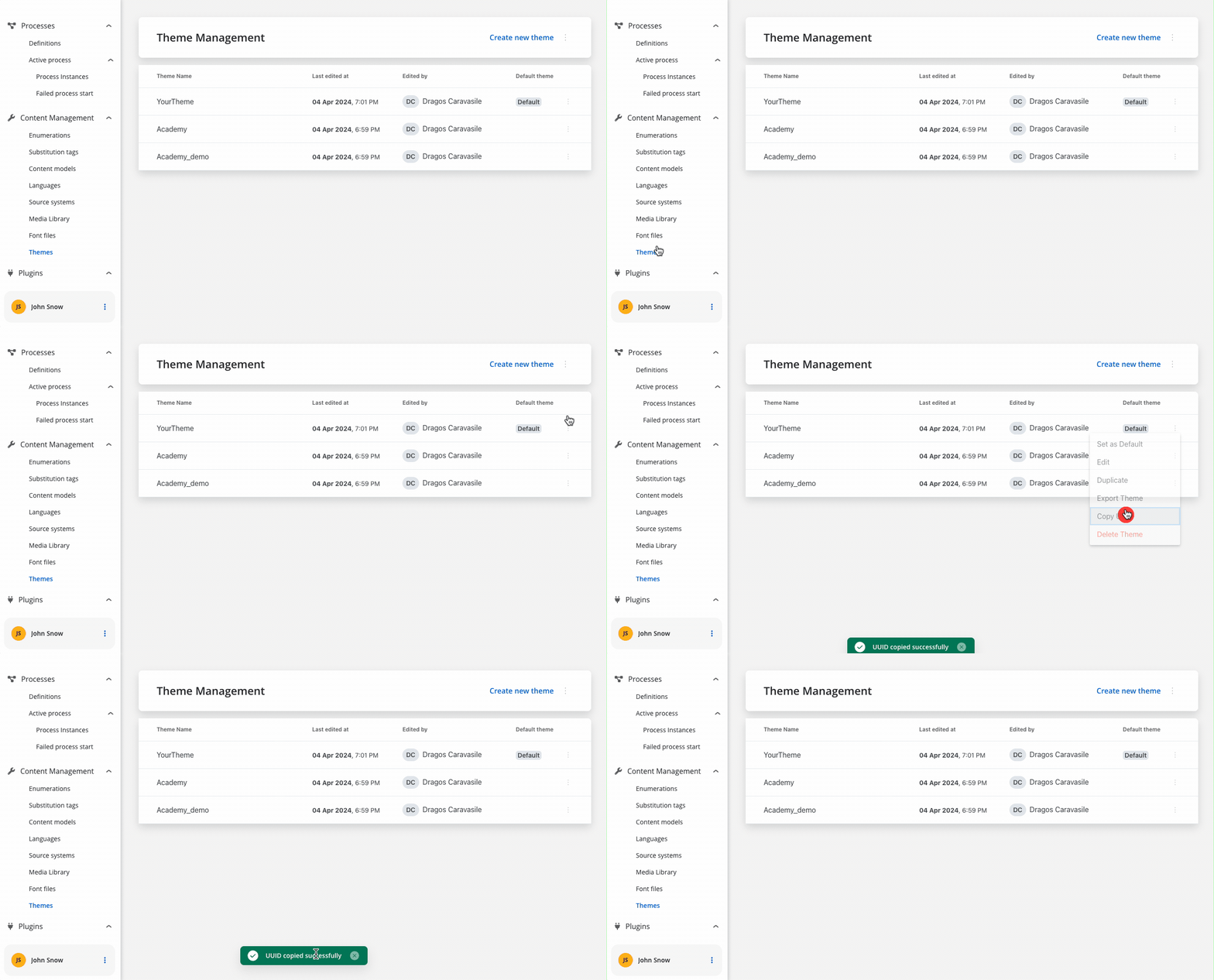
Breaking changes: Starting with version 4.0 the ui-sdk will no longer expect the authToken to be present in the LOCAL_STORAGE. Instead, the authToken will be passed as an input to the flx-process-renderer component. This is mandatory for the SSE to work properly.
Prerequisites
- Node.js min version 20 - Download Node.js
- Angular CLI version 19.2. Install Angular CLI globally using the following command:
npm install -g @angular/cli@19.2
Angular project requirements
Your app MUST be created using the NG app from the @angular/cli~19.2 package. It also MUST use SCSS for styling.
npm install -g @angular/cli@19.2
ng new my-flowx-app
To install the npm libraries provided by FLOWX you will need to obtain access to the private FlowX Nexus registry. Please consult with your project DevOps.
The library uses Angular version @angular~19.2, npm v10.1.0 and node v20.9.0.
Installing the library
Use the following command to install the renderer library and its required dependencies:
npm install \
  @flowx/core-sdk@<version>\
  @flowx/core-theme@<version> \
  @flowx/angular-sdk@<version> \
  @flowx/angular-theme@<version> \
  @flowx/angular-ui-toolkit@<version> \
  @angular/cdk@19.2 \
  @types/event-source-polyfill
Replace <version> with the correct version corresponding to your platform version.To find the right version, navigate to: Release Notes → Choose your platform version → Deployment guidelines → Component versions.
angular.json:
- in order to successfully link the pdf viewer, add the following declaration in the assets property:
{
  "glob": "**/*",
  "input": "node_modules/ng2-pdfjs-viewer/pdfjs",
  "output": "/assets/pdfjs"
}
Initial setup
Once installed, FlxProcessModule will be imported in the AppModule as FlxProcessModule.withConfig({}).
You MUST also import the dependencies of FlxProcessModule: HttpClientModule from @angular/common/http
Theming
Component theming is done through the @flowx/angular-theme library. The theme id is a required input for the renderer SDK component and is used to fetch the theme configuration. The id can be obtained from the admin panel in the themes section.
Authorization
Every request from the FlowX renderer SDK will be made using the HttpClientModule of the client app, which means those requests will go through every interceptor you define here. This is most important to know when building the auth method as it will be the job of the client app to intercept and decorate the requests with the necessary auth info (eg. Authorziation: Bearer ...).
It’s the responsibility of the client app to implement the authorization flow (using the OpenID Connect standard). The renderer SDK will expect the authToken to be passed to the flx-process-renderer as an input.
import { BrowserModule } from '@angular/platform-browser';
import { NgModule } from '@angular/core';
import { HttpClientModule, HTTP_INTERCEPTORS } from '@angular/common/http';
import { FlxProcessModule } from '@flowx/angular-sdk';
import { AppRoutingModule } from './app-routing.module';
import { AppComponent } from './app.component';

@NgModule({
  declarations: [
    AppComponent,
  ],
  imports: [
    BrowserModule,
    AppRoutingModule,
    // will be used by the renderer SDK to make requests
    HttpClientModule,
    // needed by the renderer SDK
    FlxProcessModule.withConfig({
      components: {},
      services: {},
    }),
  ],
  // this interceptor with decorate the requests with the Authorization header
  providers: [
    { provide: HTTP_INTERCEPTORS, useClass: AuthInterceptor, multi: true },
  ],
  bootstrap: [AppComponent]
})
export class AppModule {}
withConfig() call is required in the application module where the process will be rendered. The withConfig() method accepts a config argument where you can pass extra config info, register a custom component, service, or custom validators.
Custom components will be referenced by name when creating the template config for a user task.
Custom validators will be referenced by name (currentOrLastYear) in the template config panel in the validators section of each generated form field.
// example with custom component, custom services and custom validator
FlxProcessModule.withConfig({
  components: {
    YourCustomComponentIdentifier: CustomComponent,
  },
  services: {
    NomenclatorService,
    LocalDataStoreService,
  },
  validators: { currentOrLastYear },
})

  // example of a custom validator that restricts data selection to
  // the current or the previous year

  currentOrLastYear: function currentOrLastYear(AC: AbstractControl): { [key: string]: any } {
    if (!AC) {
      return null;
    }

    const yearDate = moment(AC.value, YEAR_FORMAT, true);
    const currentDateYear = moment(new Date()).startOf('year');
    const lastYear = moment(new Date()).subtract(1, 'year').startOf('year');

    if (!yearDate.isSame(currentDateYear) && !yearDate.isSame(lastYear)) {
      return { currentOrLastYear: true };
    }

    return null;
  }
The error that the validator returns MUST match the validator name.
<flx-process-renderer></flx-process-renderer> component. A list of accepted inputs is found below:
<flx-process-renderer
  [apiUrl]="baseApiUrl"
  [processApiPath]="processApiPath"
  [authToken]="authToken"
  [themeId]="themeId"
  [processName]="processName"
  [processStartData]="processStartData"
  [workspaceId]="workspaceId"
  [debugLogs]="debugLogs"
  [keepState]="keepState"
  [language]="language"
  [legacyHttpVersion]="legacyHttpVersion"
  [projectInfo]="projectInfo"
  [locale]="locale",
  [cache]="cache"
/>
Parameters
| Name | Description | Type | Mandatory | Default value | Example |
|---|
| apiUrl | Your base url | string | true | - | https://yourDomain.dev |
| processApiPath | Process subpath | string | true | - | onboarding |
| authToken | Authorization token | string | true | - | ‘eyJhbGciOiJSUzI1NiIsIn…‘ |
| themeId | Theme id used to style the process. Can be obtained from the themes section in the admin | string | true | - | ‘123-456-789’ |
| processName | Identifies a process | string | true | - | client_identification |
| workspaceId | Workspace id | string | true | - | ‘8f52744-8403-4e8d…‘ |
| processStartData | Data required to start the process | json | true | - | { "firstName": "John", "lastName": "Smith"} |
| debugLogs | When set to true this will print WS messages in the console | boolean | false | false | - |
| language | Language used to localize the application. | string | false | en | - |
| keepState | By default all process data is reset when the process renderer component gets destroyed. Setting this to true will keep process data even if the viewport gets destroyed | boolean | false | false | - |
| isDraft | When true allows starting a process in draft state. *Note that isDraft = true requires that processName be the id (number) of the process and NOT the name. | boolean | false | false | - |
| legacyHttpVersion | Set this to true only for HTTP versions < 2 in order for SSE to work properly. Can be omitted otherwise. | boolean | false | false | - |
| projectInfo | Information about the project that contains the process that is being run. | object | true | - | { projectId: '1234-5678-9012' } |
| locale | Locale used to localize the application. | string | false | en-US | ’en-US’ |
| cache | Caching of CMS resources (cached resources include: theme configurations, substitution tags, enumerations, media library assets) | boolean | false | true | - |
| customLoader | Custom loader components for different loading scenarios | object | false | - | { startProcess: StartLoaderComponent, saveData: SaveLoaderComponent } |
When the cache is enabled, these CMS resources are stored in the browser’s cache storage, which significantly improves performance and loading times by reducing repeated network requests for the same resources.Environment Recommendations
- During Development: It is recommended to disable caching by setting
[cache]="false" to ensure you are always working with the latest resources. This prevents outdated assets from being used during active development.
- For Production: Always keep caching enabled (
[cache]="true") to maximize performance and optimize resource loading times.
Data and actions
Custom components will be hydrated with data through the $data input observable which must be defined in the custom component class.
@Component({
  selector: 'my-custom-component',
  templateUrl: './custom-component.component.html',
  styleUrls: ['./custom-component.component.scss'],
})
export class CustomComponentComponent  {
  data$ = input<Observable<any> | null>(null)
}
data -> actionsFn key.
Action names are configurable via the process editor.
# data object example
data: {
    actionsFn: {
      action_one: () => void;
      action_two: () => void;
    }
  }
Custom component validation
Custom components can validate their own status. We can inject the FLX_VALIDATOR_SERVICE service and use it to validate the component. Whe service exposes the following properties:
validate(isValid: boolean) - used to validate the componentsaveData(data: any) - used to save datavalidated$ - used to monitor external submission from the process
Example of the a custom component that validates an input with a required validator:
@Component({
  selector: 'flx-custom-validation',
  imports: [CommonModule, ReactiveFormsModule],
  template: `
    Custom validation:
    <input [formControl]="fc" />
    @if (formSubmitted() && fc.invalid) {
      <span>error</span>
    }
  `
})
export class FlxCustomValidationComponent implements OnInit {
  data$ = input<Observable<any> | null>(null) // can be used to get process data & actions

  validationService = inject(FLX_VALIDATOR_SERVICE) // service used to validate the custom component - ony use in components that need validation

  fc = new FormControl('', Validators.required) // the form control has a required validator.
  formSubmitted = signal(false)

  ngOnInit(): void {
    // update validity
    this.fc.statusChanges.subscribe((status) => {
      this.validationService.validate(status === 'VALID')
    })
    // save data
    this.fc.valueChanges.subscribe((value) => {
      this.validationService.saveData({ app: { test1: value, test2: `${value}${value}` } })
    })
    // monitor external submission
    this.validationService.validated$.subscribe(() => {
      this.formSubmitted.set(true)
    })
  }
}
Custom Interceptors
- Starting from the FlowX SDKs version 4.6, the Angular
HttpClientModule is no longer used internally to make HTTP requests. Thus, we have a new mechanism that allows you to create custom interceptors for handling HTTP requests.
Request Interceptors
- Here is an example that illustrates how to create an interceptor that adds a custom header to all outgoing requests:
// Import the necessary types
import { FLX_REQUEST_INTERCEPTORS_CONFIG } from '@flowx/angular-sdk'
import { HttpRequestInterceptor } from '@flowx/core-sdk'

// create the interceptor factory function

const customHeaderInterceptor: HttpRequestInterceptor[] = [
  {
    onFulfilled: (response) => {
      response.headers['custom-header'] = 'custom-value'
      return response
    },
  }
]

// Add the interceptor to the providers array in the main app module

{
  provide: FLX_REQUEST_INTERCEPTORS_CONFIG,
  useValue: customHeaderInterceptor,
}
Response Interceptors
- Here is an example that illustrates how to create an interceptor that shows a message when a response errors out:
import { FLX_RESPONSE_INTERCEPTORS_CONFIG } from '@flowx/angular-sdk'
import { HttpResponseInterceptor } from '@flowx/core-sdk'

const customHErrorInterceptor: HttpResponseInterceptor[] = [
  {
    onRejected: (response) => {
      if (response.status !== 200) {
        console.error('Something went wrong, we should handle this!', response.message)
      }
      return response
    }
  }
]

// Add the interceptor to the providers array in the main app module
{
  provide: FLX_RESPONSE_INTERCEPTORS_CONFIG,
  useValue: customHErrorInterceptor,
}
Interceptors that use Dependency injection
- If you need to use a service in your interceptor, you can use provider factories coupled with the
deps property to inject the service into the interceptor:
// the interceptor factory function that receives the custom service as an argument through dependency injection:
const interceptor: (custom: any) => HttpRequestInterceptor[] = (customService: CustomService) => [{
  onFulfilled: (response) => {
    // do something with the custom service
    // interceptor logic
    return response
  }
}]

// Add the interceptor to the providers array in the main app module
{
  provide: FLX_REQUEST_INTERCEPTORS_CONFIG,
  useFactory: (customService: CustomService) => [
    interceptorFactory(customService),
  ],
  deps: [CustomService], // provider factory dependencies
}
Using custom icons
The SDK provides a mechanism for using custom icons. Providers for custom icons should be included in the main app module in order to be available for the whole application.
import { FlxIconModule } from '@flowx/angular-ui-toolkit'

// create a custom dictionary of icons
const customIconDictionary = {
  'custom-icon': 'custom icon svg'
}

// add the custom icon dictionary to the providers array in the main app module.
providers: [
  ...
  importProvidersFrom(FlxIconModule),
  provideExtraIconSet(customIconDictionary),
]
Process end handling
The SDK provides a mechanism for container applications to handle process completion events through the (processEnd) output event. This allows you to implement custom logic when a main process reaches an end state, such as redirecting users or triggering cleanup operations.
The processEnd event is triggered when the main process (not subprocesses) reaches any terminal state:
FINISHED - Process completed successfullyFAILED - Process encountered an errorABORTED - Process was manually terminated- Other terminal states
Only the main process triggers this event. Subprocess completions do not trigger the event to avoid unnecessary interruptions during complex process flows.
Implementation
To handle process end events, bind to the (processEnd) output event of the <flx-process-renderer> component:
import { Component } from '@angular/core';
import { Router } from '@angular/router';

@Component({
  selector: 'app-process',
  template: `
    <flx-process-renderer
      [apiUrl]="apiUrl"
      [authToken]="authToken"
      [processName]="processName"
      [processStartData]="processStartData"
      [workspaceId]="workspaceId"
      [processApiPath]="processApiPath"
      [themeId]="themeId"
      [projectInfo]="projectInfo"
      (processEnd)="onProcessEnd()"
    />
  `
})
export class ProcessComponent {
  constructor(private router: Router) {}

  onProcessEnd(): void {
    // Your custom logic here
    console.log('Process has ended');

    // Example: Redirect to home page
    this.router.navigate(['/dashboard']);
  }
}
Custom loader
The SDK provides a mechanism for container applications to customize the loader UI displayed during process execution. This allows you to replace the default FlowX loader with your own custom implementation based on different loading scenarios.
Configuration
To configure custom loaders, add them to the FlxProcessModule.withConfig() method in your application module:
import { FlxProcessModule } from '@flowx/angular-sdk';
import { Type } from '@angular/core';

// Define your custom loader components
@Component({
  selector: 'app-start-loader',
  template: `
    <div class="custom-start-loader">
      <div class="spinner"></div>
      <p>Starting process...</p>
    </div>
  `
})
export class StartProcessLoaderComponent {}

@Component({
  selector: 'app-specific-action-loader',
  template: `
    <div class="custom-specific-action-loader">
      <div class="spinner"></div>
      <p>Executing specific action...</p>
    </div>
  `
})
export class SpecificActionLoaderComponent {}

// Register the custom loaders in your app module
@NgModule({
  imports: [
    FlxProcessModule.withConfig({
      customLoader: {
        startProcess: StartProcessLoaderComponent,
        // reloadProcess: ReloadProcessLoaderComponent,
        // defaultAction: DefaultActionLoaderComponent,
        // defaultUpload: DefaultUploadLoaderComponent,
        actions: {
          action1: SpecificActionLoaderComponent,
          // action2: SaveDataLoaderComponent,
        },
      },
      components: {},
      services: {},
    }),
  ],
})
export class AppModule {}
API Specification
The custom loader configuration accepts an object of type CustomLoader:
type CustomLoader = {
  actions?: Record<string, Type<any>>
  startProcess?: Type<any>
  reloadProcess?: Type<any>
  defaultAction?: Type<any>
  defaultUpload?: Type<any>
}
Loader Types
startProcess - Displayed when starting or resuming a processreloadProcess - Displayed when reloading a processdefaultAction - Default loader for actions when loaderType is 'action'. Used when no specific action loader is found in the actions recorddefaultUpload - Default loader for file uploads when loaderType is 'upload'actions - Record mapping specific action identifiers to custom loaders. When an action is executed, the SDK will first check for a matching entry in this record before falling back to defaultAction
Fallback Behavior
If no custom loader is provided for a specific type, the SDK will automatically fall back to the built-in FlowX loader. This ensures your application continues to function even with partial custom loader configuration.
You can use substitution tags and media library assets within your custom loader components to create rich, branded loading experiences that match your application’s design system.
Enumerations and translations
The SDK library provides a mechanism for handling enumerations and translations. The api for the method that handles enumerations is provided by the getEnumeration method which is Promise based.
These methods should only be used in custom components and within a process context because internal requests depend on the presence of a running project details.
Custom enumerations
import {getEnumeration} from '@flowx/angular-sdk'

// get an enumeration by name
const enumeration = await getEnumeration('enumerationName')

// get enumeration with a parent
const enumeration = await getEnumeration('enumerationName', 'parentName')

// get enumerations and cache the result for subsequent calls
const enumerations = await getEnumerations('enumerationName', null, true)
Translations
The SDK provides a FlxLocalizePipe that allows you to manage translations within your application. The pipe is standalone and can be used both in templates and in custom components.
- Here is an example of how to use the pipe in a template:
// import the pipe in the module where you want to use it
import { FlxLocalizePipe } from '@flowx/angular-sdk'

imports: [
  ...
  FlxLocalizePipe
]
<!-- use the pipe in the template of a custom component -->
<span>{{ 'hello' | flxLocalize }}</span>
- Here is an example of how to use the pipe in a custom component:
const localize = new FlxLocalizePipe()
const translatedText = localize.transform('@@substitution_tag')
Analytics
The SDK provides a mechanism for collecting analytics events through a unified CustomEvent system. These events can be used to track screens and action events.
import {
   ANALYTICS_EVENTS,
   AnalyticsData,
   pushAnalyticsData,
} from '@flowx/core-sdk';
Emitting Analytics Events
Analytics events are dispatched using the pushAnalyticsData(payload: AnalyticsData) method. The SDK defines two event types:
enum ANALYTICS_EVENTS {
  SCREEN = 'SCREEN',
  ACTION = 'ACTION',
}
type AnalyticsData = {
  type: ANALYTICS_EVENTS;
  value: string;
  screen?: string;
  component?: string;
  label?: string;
  customPayload?: object;
}
The value property represents the identifier set in the process definition.For ACTION type events there are some additional properties provided:
- component - The type of component triggering the action
- label - The label of the component
- screen - The identifier of the screen containing the component, if set
Listening for Analytics Events
You can subscribe to analytics events using the standard CustomEvent API:
ngOnInit(): void {
  document.addEventListener('flowx:analytics', this.analyticsListener);
}

analyticsListener = (event: CustomEvent<AnalyticsData>) => {
  console.log('Received flowx:analytics event:', event.detail);
};

ngOnDestroy(): void {
  document.removeEventListener('flowx:analytics', this.analyticsListener);
}
Ensure that you remove the event listener on component destruction to avoid memory leaks.
Custom Payload
This functionality, allowing you to capture and send custom data alongside standard analytics events.
When analytics custom payload is configured in FlowX Designer, the renderer automatically processes variable substitution and includes the resulting data in analytics events.
Receive custom payload configuration
The renderer receives the analytics configuration as a JSON string with variable placeholders:"analyticsCustomPayload": "{\n \"name\": ${app.input}\n}"
Process variable substitution
The SDK replaces variables with actual values from the process data store:{
"name": "${app.input}",
"client": "${app.client}",
"amount": "${app.amount}"
}
Add to analytics event
The processed payload is included in the analytics event under the customPayload property:// Analytics event structure with custom payload
{
type: 'ACTION', // or 'SCREEN'
info: {
value: 'Save personal data',
screen: 'Personal Data',
component: 'BUTTON',
label: 'Save',
customPayload: {
name: "john",
client: { id: "123", name: "John Doe" },
amount: 1500
}
}
}
Caching
The SDK provides a caching mechanism for static resources. The cache is enabled by default and can be disabled by setting the cache input of the flx-process-renderer component to false. When turned on, the cache will store the static resources in the browser’s cache storage.
Common Scenario: When making updates to CMS resources (like substitution tags or media library images) during development, you may find that after a browser refresh, the changes don’t appear.
Important: This issue is most commonly encountered when transitioning from versions before 4.7.x to version 4.7.x or newer, as the caching behavior changed
Common Scenario: When making updates to CMS resources (like substitution tags or media library images) during development, you may find that after a browser refresh, the changes don’t appear.
Important: This issue is most commonly encountered when transitioning from versions before 4.7.x to version 4.7.x or newer, as the caching behavior changed
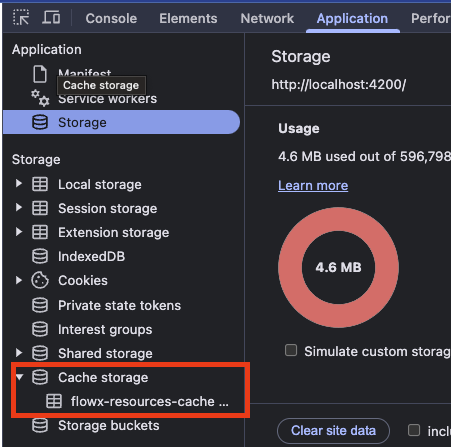
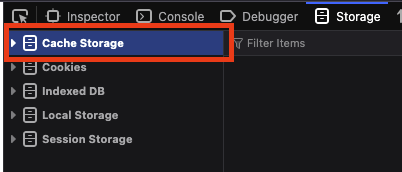
Application (Chrome) or Storage (Firefox) tab in the browser Dev tools and either clear the cache or disable the cache for the current site.
| Browser | Dev Tools Tab | Screenshot |
|---|
| Chrome | Application tab | |
| Firefox | Storage tab | |
- Chrome: Navigate to Application → Storage → Cache storage → Right-click on “flowx-resources-cache” → Clear
- Firefox: Navigate to Storage → Cache Storage → Right-click → Clear
Interacting with the process
Data from the process is communicated via the Server Send Event protocol under the following keys:
| Name | Description | Example | |
|---|
| Data | data updates for process model bound to default/custom components | | |
| ProcessMetadata | updates about process metadata, ex: progress update, data about how to render components | | |
| RunAction | instructs the UI to perform the given action | | |
Chat component
To use the FlxChatRendererComponent component, import the module in your project:
import { FlxChatRendererComponent } from '@flowx/angular-sdk';
Usage
Include the component in your template:
<flx-chat-renderer
  [apiUrl]="apiUrl"
  [authToken]="accessToken()"
  [staticAssetsPath]="staticAssetsPath"
  [language]="language()"
  [locale]="locale()"
  [themeId]="themeId()"
  [projectId]="projectId()"
  [workspaceId]="workspaceId()"
  [source]="source()"
  [chatConfig]="parsedChatConfig()"
  [cache]="cache()"
/>
| Name | Description | Type | Mandatory | Example |
|---|
apiUrl | Your base API URL | string | ✅ | https://yourDomain.dev |
authToken | Authorization token | string | ✅ | (retrieved from auth provider) |
staticAssetsPath | Path for static resources | string | ❌ | (set via environment) |
language | Language used to localize the chat interface | string | ❌ | en |
locale | Locale setting for date and number formatting | string | ❌ | en-US |
themeId | Theme identifier for styling | string | ❌ | (retrieved dynamically) |
projectId | The FlowX project ID | string | ✅ | (retrieved dynamically) |
workspaceId | The workspace ID | string | ✅ | (retrieved dynamically) |
source | Source object with type and id | object | ✅ | { type: 'WORKFLOW', id: '...' } |
chatConfig | Chat configuration object | object | ❌ | { welcomeMessage: '...', ... } |
cache | Enable caching for chat responses | boolean | ❌ | true |
chatConfig parameters
The chatConfig object accepts the following properties:
| Name | Description | Type | Default value |
|---|
welcomeMessage | Message displayed when chat is first opened | string | 'Welcome to the chat!' |
thinkingMessage | Message displayed while waiting for response | string | 'Thinking...' |
title | Chat window title | string | 'Chat' |
subtitle | Chat window subtitle | string | 'Chat subtitle' |
showChatIcon | Whether to display the chat icon | boolean | true |
showSeparator | Whether to show separator between messages | boolean | true |
newChatLabel | Label for the new chat button | string | 'New chat' |
inputPlaceholder | Placeholder text for the message input field | string | 'Enter your message' |
maxInputRows | Maximum number of rows for the input field | number | 10 |
Task management component
The flx-task-manager component is available in the FlxTaskManagementComponent. To use it, import the required module in your Angular project:
import { FlxTasksManagementComponent } from '@flowx/angular-sdk';
Usage
Include the component in your template:
<flx-task-management
      [apiUrl]="apiUrl"
      [authToken]="accessToken"
      [appId]="appId()"
      [language]="language()"
      [themeId]="themeId()"
      [staticAssetsPath]="staticUrl"
      [viewDefinitionId]="viewDefinitionId()"
      [locale]="locale()"
      [buildId]="buildId()"
      [workspaceId]="workspaceId()"
  ></flx-task-management>
| Name | Description | Type | Mandatory | Example |
|---|
apiUrl | Endpoint where the tasks are available | string | ✅ | https://yourDomain.dev/tasks |
authToken | Authorization token | string | ✅ | (retrieved from local storage) |
appId | The application ID | string | ✅ | (retrieved dynamically) |
viewDefinitionId | The view configuration identifier | string | ✅ | (retrieved dynamically) |
workspaceId | The workspace ID | string | ✅ | (retrieved dynamically) |
themeId | The theme identifier | string | ❌ | (retrieved dynamically) |
language | The selected language | string | ❌ | (retrieved dynamically) |
locale | The localization setting | string | ❌ | (retrieved dynamically) |
buildId | The current build identifier | string | ❌ | (retrieved dynamically) |
staticAssetsPath | Path for static resources | string | ❌ | (set via environment) |
Task management public API
The Angular SDK provides a comprehensive public API for building custom task management interfaces.
This API allows you to fetch tasks, manage comments, handle task actions, and interact with task data programmatically.
Importing the Service
To use the task management public API, inject the PublicTasksService from @flowx/angular-sdk:
import { PublicTasksService } from '@flowx/angular-sdk';
import { inject } from '@angular/core';

export class MyComponent {
  private taskService = inject(PublicTasksService);
}
Available Types
The Angular SDK exports the following types for task management:
import {
  PublicTasksService,
  TMView,
  TMViewTask,
  TMViewColumn,
  TMTaskComment,
  TMTaskHistory,
  TMUser,
  TMEnumerations,
  TMFilterOperators,
  TMFilters,
  TMSort,
  TMPaginatedResponse,
  TMSetupOptions,
  TMExecuteTaskActions,
  TMOperatorsType,
} from '@flowx/angular-sdk';
Initialization
Before using the task management API, you need to initialize the task manager resources. This fetches the view configuration, enumerations, and filter operators.
this.taskService.getTaskManagerResources({
  apiUrl: 'https://yourDomain.dev/tasks',
  authToken: 'your-auth-token',
  appInfo: { appId: 'app-123' },
  viewId: 'view-456',
  workspaceId: 'workspace-789',
  themeId: 'theme-012', // Optional
  language: 'en', // Optional
  locale: 'en-US', // Optional
  buildId: 'build-345', // Optional
  staticAssetsPath: '/static', // Optional
}).subscribe(({ view, enumerations, filterOperators }) => {
  // Use the view, enumerations, and filterOperators
});
| Name | Description | Type | Mandatory | Example |
|---|
apiUrl | Endpoint where the tasks are available | string | ✅ | https://yourDomain.dev/tasks |
authToken | Authorization token | string | ✅ | (retrieved from local storage) |
appInfo | Application information object containing appId | { appId: string } | ✅ | { appId: "app-123" } |
viewId | The view configuration identifier | string | ✅ | (retrieved dynamically) |
workspaceId | The workspace ID | string | ✅ | (retrieved dynamically) |
themeId | The theme identifier | string | ❌ | (retrieved dynamically) |
language | The selected language | string | ❌ | "en" |
locale | The localization setting | string | ❌ | "en-US" |
buildId | The current build identifier | string | ❌ | (retrieved dynamically) |
staticAssetsPath | Path for static resources | string | ❌ | (set via environment) |
view: The view configuration object (TMView)enumerations: Available enumeration options for filters (TMEnumerations)filterOperators: Available filter operators for each column (TMFilterOperators)
Fetching Tasks
getViewTasks
Fetches tasks for a specific view with support for sorting, filtering, pagination, and search.
this.taskService.getViewTasks(
  page,      // Page number (0-based)
  sort,      // Array of sort configurations
  filters,   // Array of filter configurations
  keyword,   // Search string
  size       // Page size
).subscribe((response) => {
  const tasks = response.content; // Array of TMViewTask objects
});
| Name | Description | Type | Mandatory | Example |
|---|
page | Page number (0-based) | number | ✅ | 0 |
sort | Array of sort configurations | TMSort[] | ✅ | [{ keyName: "priority", direction: "ASC" }] |
filters | Array of filter configurations | TMFilters[] | ✅ | See filter examples below |
keyword | Search string for task search | string | ✅ | "urgent" |
size | Number of items per page | number | ✅ | 10 |
TMPaginatedResponse<TMViewTask> containing:
content: Array of TMViewTask objectstotalElements: Total number of taskstotalPages: Total number of pages- Other pagination metadata
getViewTask
Fetches a specific task by ID and token UUID.
this.taskService.getViewTask(taskId, tokenUuid)
  .subscribe((task) => {
    // Use the task
  });
| Name | Description | Type | Mandatory | Example |
|---|
taskId | The unique task ID | string | ✅ | "task-123" |
tokenUuid | The token UUID associated with task | string | ✅ | "token-uuid-456" |
TMViewTask object.
Task Details
getTaskComments
Fetches all comments for a specific task.
this.taskService.getTaskComments(taskId)
  .subscribe((comments) => {
    // Use the comments array
  });
| Name | Description | Type | Mandatory | Example |
|---|
taskId | The unique task ID | string | ✅ | "task-123" |
TMTaskComment objects.
getTaskHistory
Fetches the history/audit trail for a specific task.
this.taskService.getTaskHistory(taskId)
  .subscribe((history) => {
    // Use the history array
  });
| Name | Description | Type | Mandatory | Example |
|---|
taskId | The unique task ID | string | ✅ | "task-123" |
TMTaskHistory objects.
getAssignees
Fetches available assignees for a task, with optional search filtering.
this.taskService.getAssignees(task, { keyword: 'john' })
  .subscribe((users) => {
    // Use the users array
  });
| Name | Description | Type | Mandatory | Example |
|---|
task | The task object | TMViewTask | ✅ | (task object) |
query | Search options | { keyword: string } | ✅ | { keyword: "john" } |
TMUser objects.
getBulkAssignees
Fetches available assignees for multiple tasks in bulk.
this.taskService.getBulkAssignees(
  [{ id: 'task-1', tokenUuid: 'token-1' }, { id: 'task-2', tokenUuid: 'token-2' }],
  { keyword: 'john' }
).subscribe((users) => {
  // Use the users array
});
| Name | Description | Type | Mandatory | Example |
|---|
tasks | Array of task objects with id and tokenUuid | { id: string; tokenUuid: string }[] | ✅ | [{ id: "task-1", tokenUuid: "token-1" }] |
query | Search options | { keyword: string } | ✅ | { keyword: "john" } |
TMUser objects.
Task Actions
executeTaskAction
Executes an action on a specific task (e.g., assign, complete, cancel).
this.taskService.executeTaskAction(action, task, payload)
  .subscribe(() => {
    // Action completed
  });
| Name | Description | Type | Mandatory | Example |
|---|
action | The action to execute | TMExecuteTaskActions | ✅ | TaskActions.ASSIGN |
task | The task object | TMViewTask | ✅ | (task object) |
payload | Additional payload (e.g., username for assign) | any | ❌ | "john.doe" |
TaskActions.ASSIGN - Assign task to a userTaskActions.COMPLETE - Mark task as completeTaskActions.CANCEL - Cancel the taskTaskActions.CHANGE_PRIORITY - Change task priorityTaskActions.VIEW - View task details
bulkUpdate
Applies an action to multiple tasks at once.
this.taskService.bulkUpdate(
  [{ id: 'task-1', tokenUuid: 'token-1' }, { id: 'task-2', tokenUuid: 'token-2' }],
  TaskActions.COMPLETE,
  'username' // Optional, for assign action
).subscribe(() => {
  // Bulk action completed
});
| Name | Description | Type | Mandatory | Example |
|---|
tasks | Array of task objects with id and tokenUuid | { id: string; tokenUuid: string }[] | ✅ | [{ id: "task-1", tokenUuid: "token-1" }] |
action | The action to execute | TMExecuteTaskActions | ✅ | TaskActions.COMPLETE |
username | Username for assign action | string | ❌ | "john.doe" |
updatePriority
Updates the priority of a specific task.
this.taskService.updatePriority(taskId, priority)
  .subscribe(() => {
    // Priority updated
  });
| Name | Description | Type | Mandatory | Example |
|---|
taskId | The unique task ID | string | ✅ | "task-123" |
priority | New priority value | number | ✅ | 5 |
addComment
Adds a new comment to a task.
this.taskService.addComment(taskId, { message: 'New comment text' })
  .subscribe((comment) => {
    // Comment added, use the returned comment
  });
| Name | Description | Type | Mandatory | Example |
|---|
taskId | The unique task ID | string | ✅ | "task-123" |
comment | Comment data object | { message: string } | ✅ | { message: "New comment text" } |
TMTaskComment object.
deleteComment
Removes a comment from a task.
this.taskService.deleteComment(taskId, commentId)
  .subscribe(() => {
    // Comment deleted
  });
| Name | Description | Type | Mandatory | Example |
|---|
taskId | The unique task ID | string | ✅ | "task-123" |
commentId | The unique comment ID | string | ✅ | "comment-456" |
Service State Management
getView
Gets the current view configuration.
const view = this.taskService.getView();
TMView object or null if not initialized.
getEnumerations
Gets the current enumerations.
const enumerations = this.taskService.getEnumerations();
TMEnumerations object.
setView
Sets the view configuration manually.
this.taskService.setView(view, format);
| Name | Description | Type | Mandatory | Example |
|---|
view | The view configuration object | TMView | ✅ | (view object) |
format | Whether to format the view | boolean | ❌ | false |
Real-time Updates (SSE)
initSse
Initializes a Server-Sent Events (SSE) connection for real-time task updates.
this.taskService.initSse();
getTaskManagerResources().
getSseEvents
Gets an Observable stream of SSE events.
this.taskService.getSseEvents()
  .subscribe((event) => {
    // Handle SSE event
    console.log('SSE event:', event);
  });
MessageEvent<string> objects.
closeSseConnection
Closes the SSE connection.
ngOnDestroy(): void {
  this.taskService.closeSseConnection();
}
Coding style tests
Always follow the Angular official coding styles.
Below you find a Storybook which demonstrates how components behave under different states, props, and conditions, it allows you to preview and interact with individual UI components in isolation, without the need for a full-fledged application: